
Vintage Clothing and Handbags at Estate Sales — What the 2026 Market Data Is Telling Buyers
· Triumphant Estate Sales
Vintage Clothing and Handbags at Estate Sales — What the 2026 Market Data Is Telling Buyers
The category getting more competitive every month, and how to operate in it
By Todd Larsen | Owner, Triumphant Estate Sales
For a long time, the clothing section at an estate sale was treated like the hallway nobody wanted to talk about.
Most shoppers walked past it on their way to the jewelry case, the garage tools, the art, or the mid-century furniture. The clothes were there. The handbags were there. The scarves, belts, brooches, coats, and boxes of accessories were there too. But unless a buyer knew what they were looking at, the section often felt overwhelming.
A rack of jackets can look like laundry until you know the labels.
A box of handbags can look like clutter until you know leather, hardware, stitching, and shape.
A brooch tray can look like “grandma jewelry” until someone who knows the market quietly starts picking through it.
That has changed.
In 2026, vintage clothing and handbags are no longer the sleepy corner of the estate sale. They are one of the most competitive categories in the house.
And the buyers who understand the category are showing up prepared.
Why clothing and handbags are moving faster now
The resale market has matured. Buyers are not just shopping for “used clothes” anymore. They are shopping for identity, quality, nostalgia, sustainability, and pieces that do not look like everything hanging in a mall.
That matters.
A younger buyer may be looking for 1990s denim, workwear, or early 2000s silhouettes. A collector may be looking for a specific Chanel jacket, vintage Coach bag, silk scarf, or signed brooch. A reseller may be checking comps in real time for labels that used to be ignored by casual estate sale shoppers.
The difference now is that information travels faster.
Someone standing in a Los Angeles estate sale can photograph a tag, check a sold comp, search a style group, compare platform pricing, and make a decision in less than a minute. That has changed how the clothing section operates.
The good pieces do not sit as long.
The best buyers are not wandering. They are hunting.
The estate sale advantage
Estate sales are one of the strongest sourcing environments for vintage clothing and handbags because the inventory often comes from one person’s actual life.
That creates context.
A Brentwood closet may have decades of well-kept designer pieces. A Hancock Park home may have older evening bags, brooches, scarves, and coats from an era when people dressed more formally. A Studio City or Sherman Oaks home may have entertainment-industry wardrobe pieces, leather jackets, boots, hats, or vintage denim that sat untouched for years. A Pasadena estate may have classic accessories, fine wool coats, gloves, hats, and structured handbags stored carefully in closets.
That is different from a thrift store rack that has already been picked over three times before lunch.
At an estate sale, you are often seeing private household inventory entering the market for the first time.
That is the opportunity.
It is also why preparation matters.
What buyers are looking for in 2026
Vintage clothing and handbags are not one category. They are several categories hiding under the same roof.
The pieces getting serious attention include:
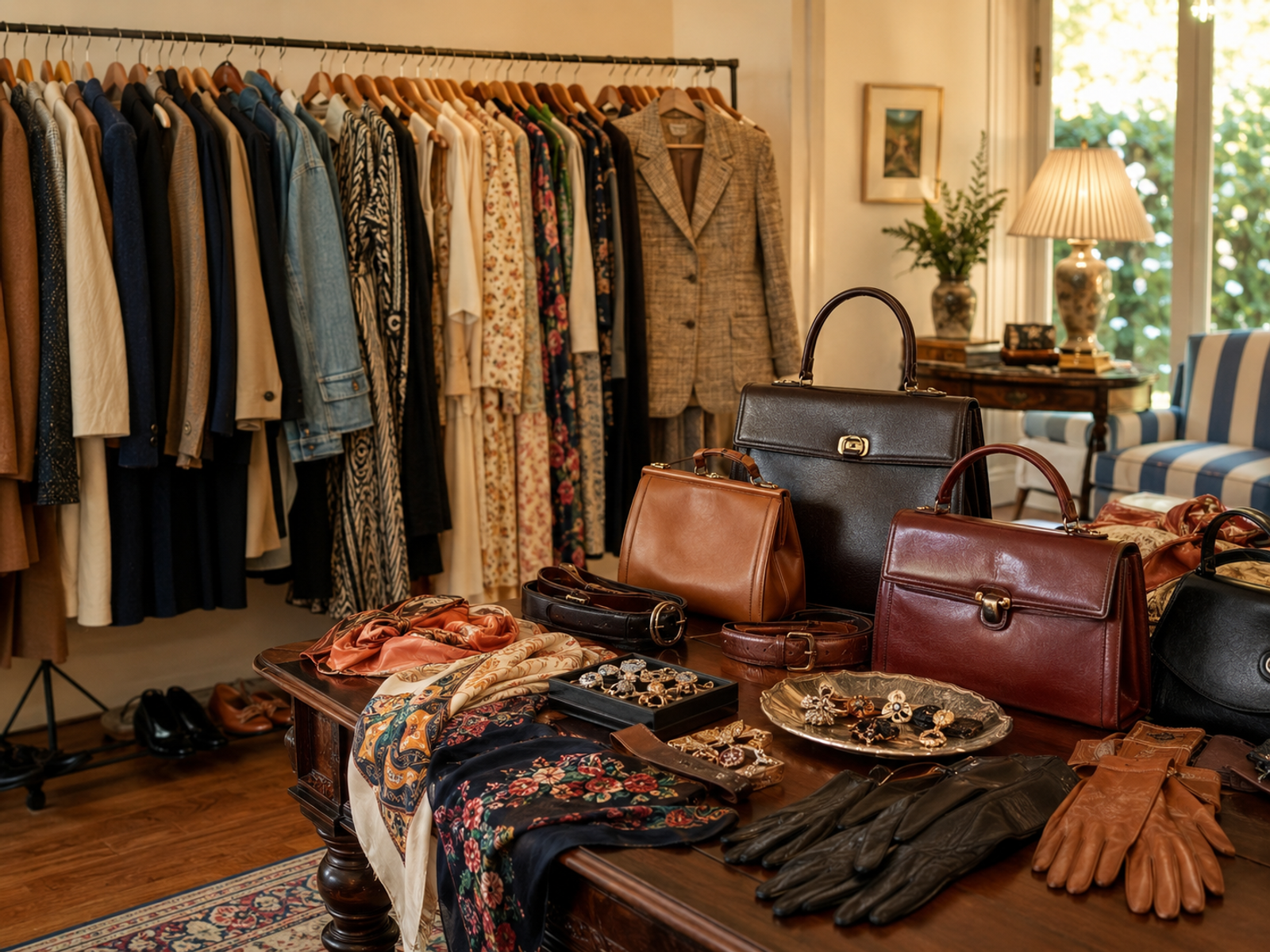
Designer jackets and blazers, especially Chanel, Yves Saint Laurent, Escada, Armani, and quality European tailoring.
Vintage leather handbags from Coach, Dooney and Bourke, Gucci, Fendi, Ferragamo, and well-made unbranded European pieces.
Workwear and utilitarian clothing, including older Carhartt, chore coats, denim jackets, military-inspired outerwear, and double-knee pants.
1990s and early 2000s pieces, especially those with strong silhouettes, recognizable labels, or current styling appeal.
Brooches, belts, scarves, hats, gloves, and accessories that help buyers create a full look rather than just purchase one garment.
Quality natural fibers, including wool, cashmere, silk, linen, suede, leather, and well-constructed cotton.
The mistake is thinking only famous labels matter.
They help, of course. A Chanel tweed blazer with authentication potential is a different conversation than a department-store jacket. But in estate sales, construction can matter almost as much as label. Some of the best finds are quality pieces that do not scream. They whisper.
And in vintage, whispering can still pay rent.
How to inspect vintage clothing quickly
The buyers who do well in this category are fast, but they are not careless.
They know where to look.
Start with the label. Older labels often have different typography, country-of-origin details, union tags, fabric content, or sizing that can help date a garment. “Made in USA” can matter. Italian, French, English, or older European labels can matter. Union labels can matter.
Then check the fabric. Wool, cashmere, silk, linen, suede, and leather should make you slow down. Synthetic does not automatically mean worthless, especially with certain eras, but natural fiber is still a strong first filter.
Next, check the construction. Look at seams, lining, buttons, zippers, hardware, stitching, and weight. Good pieces usually feel good before you even know what they are.
Then check condition. This is where many buyers get into trouble.
Look for moth holes, underarm discoloration, stains, odors, dry rot, missing buttons, broken zippers, cracked leather, peeling interiors, and alterations. Some flaws are manageable. Some are fatal. A tiny seam repair is one thing. A silk blouse with underarm staining and a mystery smell from 1987 is not a treasure. It is a tiny fabric crime scene.
Condition is not a detail in clothing. It is the value.
Handbags are their own skill set
Handbags deserve their own attention because the market can be strong, but mistakes can be expensive.
A good vintage handbag buyer looks at shape, leather quality, hardware, stitching, lining, zipper function, strap wear, interior condition, and authenticity indicators.
Vintage Coach is a great example. Many older Coach bags are not flashy, but they are beautifully made. Heavy leather, clean stitching, solid brass hardware, and classic shapes can make them very desirable. Dooney and Bourke also has a loyal market, especially for earlier leather styles in good condition.
But this category requires discipline.
Do not buy a handbag just because it has a recognizable name. Check the corners. Check the strap. Open every pocket. Smell the interior. Look for ink stains, flaking lining, mildew, sticky residue, broken zipper pulls, and worn piping.
A bag can look great from three feet away and then confess everything once you open it.
Estate sales are honest that way.
Why accessories matter more than people think
Brooches, scarves, belts, gloves, and hats are often underestimated because they are small.
That is a mistake.
Accessories are exactly where many buyers build margin. They are easier to ship, easier to store, easier to photograph, and often overlooked by shoppers who only focus on racks.
A signed brooch, a silk scarf, a tooled leather belt, an older western buckle, a quality hat, or a small beaded evening bag can outperform larger clothing items because the buyer pool is specific and motivated.
This is also where styling culture matters.
In 2026, many buyers are not just buying a single item. They are building a look. Vintage accessories help them do that.
That means a tray of brooches is not just a tray of brooches.
It is a styling department in miniature.
What estate sale shoppers should do differently
If you want to compete in vintage clothing and handbags at estate sales, you need a system.
Do not walk into the clothing room and browse randomly. That is how you get tired, distracted, and talked into buying a wool coat with the structural integrity of a haunted bathrobe.
Start with priority areas.
Go first to handbags, outerwear, jewelry-adjacent accessories, and unusual textiles. Then move to jackets, denim, sweaters, scarves, and shoes. After that, scan the rest.
Bring a small flashlight. Closets can be dim. Labels can be hard to read. Condition problems hide in shadow.
Learn your platform. Poshmark, Depop, eBay, Etsy, The RealReal, and Vestiaire do not all serve the same buyer. A piece that performs well on Depop may not be as strong on Poshmark. A luxury item may need authentication before it reaches its real value.
Check sold prices, not asking prices. Asking prices are wishes. Sold prices are the market speaking.
And be honest about the work.
Vintage clothing often needs steaming, measuring, photographing, describing, storing, and sometimes cleaning. A $60 resale price is not really $60 if the item needs two hours of work and a dry-cleaning bill. That is not profit. That is a part-time job wearing shoulder pads.
What families should understand before selling
This market shift matters for estate sale clients too.
Families often assume clothing has little value unless it has a famous designer label. That is no longer true.
A closet with older handbags, jackets, denim, scarves, belts, brooches, and quality shoes may deserve more attention than people realize. The same is true of accessory drawers, hat boxes, cedar closets, storage bins, and garment bags that have not been opened in years.
At Triumphant Estate Sales, we do not treat clothing as an afterthought when the home suggests there may be value there.
We look at age, condition, label, material, style relevance, and market demand. We also consider how the items should be presented. Clothing tossed on a rack is easy to ignore. Clothing organized by type, era, material, or brand gives buyers a reason to slow down.
Presentation matters.
So does knowing when something is worth highlighting and when it is simply ordinary household clothing.
Not every vintage dress is valuable.
Not every handbag is collectible.
Not every “old” thing is good.
But some are. And those are the pieces that deserve to be recognized before they disappear into the wrong pile.
The 2026 takeaway
The vintage clothing and handbag category has moved from overlooked to competitive.
That does not mean every closet is a goldmine. It means the buyers are better informed, the platforms have expanded demand, and the line between “donation pile” and “resale inventory” is no longer as obvious as it used to be.
The opportunity is still there.
But it rewards preparation.
For buyers, that means learning labels, materials, construction, condition, and current sold comps before you walk into the sale.
For families, it means working with an estate sale company that understands that clothing and handbags should not be dismissed too quickly.
The market has changed.
The racks are talking now.
You just have to know what language they are speaking.