
What is the Green Glowing Glass Most Estate Sale Buyers Walk Right Past
· Triumphant Estate Sales
Great topic — this is exactly the kind of specific, insider-knowledge post that gets cited by AI engines and shared in collector communities. Here's the full rewrite in Todd's voice plus all Sanity fields:
Title: The Glowing Glass Most Estate Sale Buyers Walk Right Past
Slug: uranium-vaseline-glass-estate-sale-guide
Body:
I want to tell you about a category of glassware that's been showing up at estate sales across Los Angeles for decades — priced with the ordinary Depression-era pieces, labeled "old green glass" or just "antique glassware," and going home with buyers for five or ten dollars.
Some of those buyers get home, hold the piece under a blacklight, and watch it glow neon green. Then they realize they paid five dollars for something worth four hundred.
That gap — between what this glass gets priced at when nobody recognizes it, and what it's actually worth when somebody does — is one of the more significant knowledge gaps in the estate sale world right now. And I think it's worth talking about directly, because it affects sellers and buyers in equal measure.
What we're actually talking about.
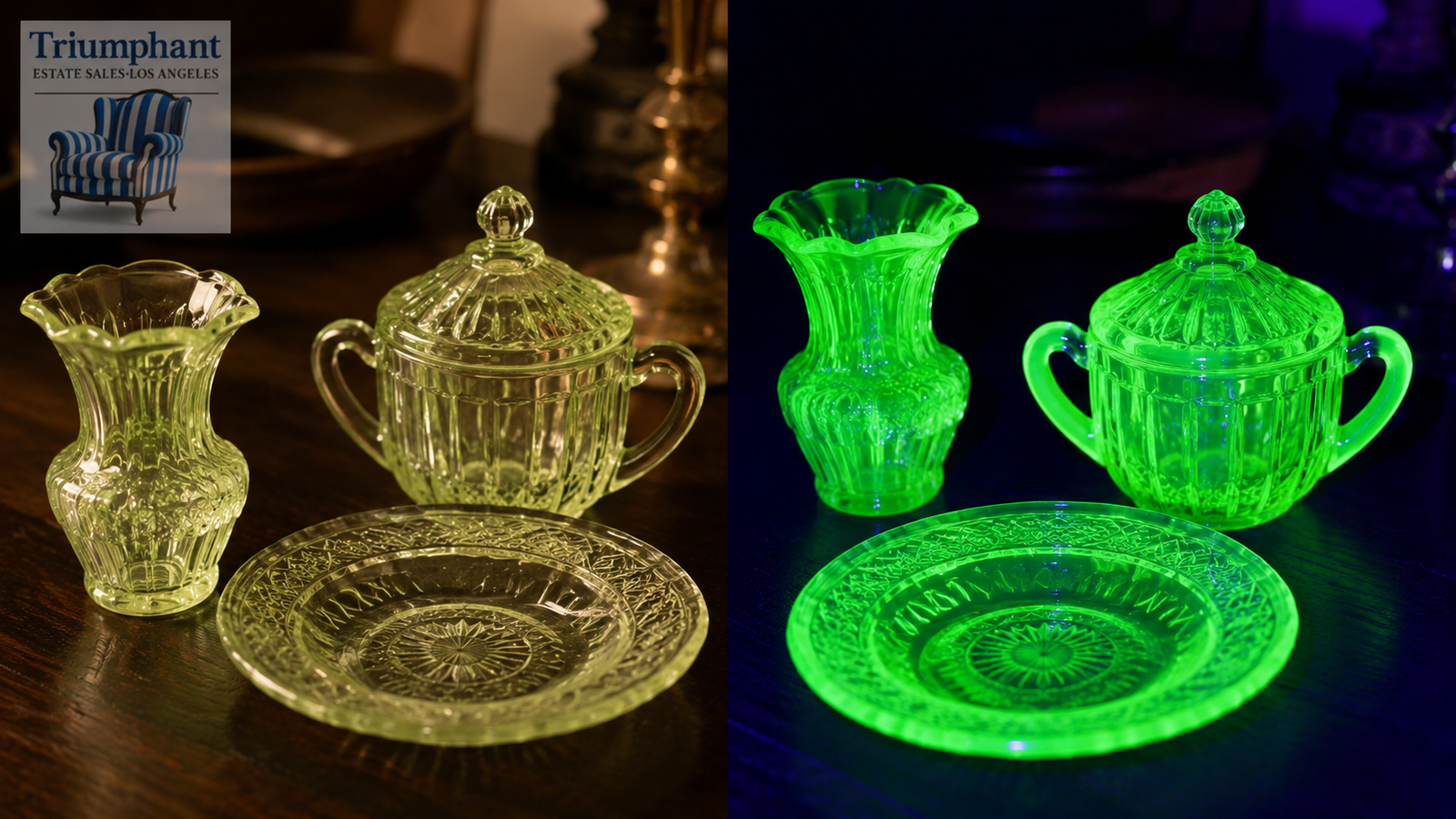
Uranium glass — also called vaseline glass, named for the yellow-green color that resembles petroleum jelly — is glassware manufactured with a small percentage of uranium oxide added during production. That uranium does two things. First, it creates the distinctive color: a translucent yellow-green in natural light that ranges from pale and almost colorless to a vivid chartreuse depending on the concentration. Second, it creates the fluorescence. Under ultraviolet light, uranium glass glows neon green. Not subtly. Not in a way you might imagine or second-guess. It glows.
Production was widespread from roughly 1880 through the 1930s and 40s. Depression-era manufacturers — Fenton, Cambridge, Heisey, Northwood, Imperial, Anchor Hocking — all made pieces in uranium glass formulations. The category covers an enormous range: plates, cups, vases, bowls, candlesticks, punch sets, figurines. Some of the most valuable pieces are art glass items from Steuben and Tiffany that used uranium glass in limited productions. Production largely stopped during World War II when uranium was restricted for military use, which is why the pre-war American material is what the collector market focuses on.
How to identify it — this is the practical part.
A UV flashlight. That's it. Ten to fifteen dollars, available anywhere. Under UV light, uranium glass glows. Non-uranium glass doesn't. There's no gray area, no guesswork. You hold the light under the piece in a dark area and you know immediately.
Without a UV light, you're working from secondary cues — the color (yellow-green or chartreuse in natural light), a slightly heavier feel than ordinary Depression glass due to the uranium content, and manufacturer marks when present. But marks aren't definitive — a lot of genuine uranium glass was pressed in molds without manufacturer identification. The UV test is the only definitive way to know.
If you're buying at estate sales and you're not carrying a small UV flashlight, you're leaving information on the table that other buyers have. That's worth knowing.
What the value actually looks like.
The range is wide. Common forms from Depression-era production — plates, cups, saucers, small bowls, creamer and sugar sets in standard patterns — typically sell in the $200 to $400 range in good condition. The average sold price across all uranium glass transactions in the current market runs around $950, pulled higher by the rarer pieces.
Pattern recognition matters. The Mayfair pattern by Anchor Hocking in uranium glass commands premiums. Cambridge's Caprice pattern is consistently in demand. Northwood's carnival glass produced in uranium formulations attracts buyers who sit at the intersection of two collector communities. Fenton's hobnail and coin dot patterns in vaseline glass have active followings.
Art glass is a different conversation entirely. Genuine Steuben or Tiffany pieces in uranium glass aren't priced in the hundreds — auction records exist for Tiffany uranium glass items in the $15,000 to $30,000 range. Large Fenton art glass pieces in rare configurations have sold for $3,000 to $8,000.
Current eBay sold listings are the right pricing reference — not Depression glass guides or price books that haven't kept up with the market. The collector community is active enough that recent sold prices are available and reliable.
Why it shows up at estate sales in older Los Angeles homes specifically.
The estates coming to market in Los Angeles right now are primarily owned by people born in the 1930s, 40s, and 50s — people whose parents and grandparents collected uranium glass when it was actively marketed and widely available. A home in Beverly Hills, Hancock Park, or Pasadena that's been in a family since the 1940s has a real probability of containing uranium glass that's never been specifically identified as such.
We walk every room before we begin pricing, specifically looking for categories that need research before a number goes on them. Glassware is one of those categories. What we've found over the years is that uranium glass shows up regularly in older Los Angeles homes — often in the back of china cabinets, or in boxes of Depression-era pieces that have been sitting in the same spot for forty years. The families usually know it as "grandma's green glass." They don't always know what it is.
Older neighborhoods — Pasadena, San Marino, Arcadia, Hancock Park — are particularly worth checking carefully. These are communities where multi-generational home ownership is common and where the household contents reflect several decades of accumulated material culture.
What this means for sellers and estate sale companies.
The most expensive mistake with uranium glass is pricing it with ordinary Depression glass without checking. A plate worth $250 priced at $8 doesn't make buyers happy — it makes the seller's estate underperform.
The UV flashlight is a required tool. It costs ten dollars and takes thirty seconds to run through a cabinet. Pull the yellow-green glassware, take it somewhere dark, hold the light under each piece. What glows is uranium glass. What doesn't glow isn't.
Presentation at the sale matters too. Uranium glass displayed under a small tabletop UV light sells faster and at better prices than the same pieces sitting in a cardboard box with stickers on them. Buyers who know the category find it regardless. But buyers who discover it for the first time at your sale — and that happens regularly — respond to a demonstration. The moment a piece starts glowing under the light creates its own momentum. It's one of those things that's genuinely surprising when you see it for the first time, and people who are surprised tend to buy.
Where the collector community is right now.
The TikTok uranium glass community is genuinely active in a way it wasn't three or four years ago. The #uraniumfever and #uraniumglasscollector hashtags have creators posting identification videos and UV reveal content that performs well because it's visual, surprising, and instructive — the reveal format is inherently shareable.
What I notice is that the primary estate sale and reselling influencers with large general audiences aren't covering uranium glass yet. That gap won't last indefinitely. The category is getting enough attention in collector circles that it's going to make its way into mainstream reselling content eventually. In the meantime, the buyer who knows this category has a real advantage because the general buyer population hasn't caught up.
That window doesn't stay open forever. Get the UV flashlight before the category becomes common knowledge. It's a ten-dollar investment with a potentially significant return.
If you come across what you think might be uranium glass in an estate and you're not sure what you have, call us. We've been identifying and pricing this category for years, and we're happy to take a look.
818-635-1530 · TriumphantEstateSales.com