
Bakelite, Catalin or Lucite? How to Tell What You've Really Found
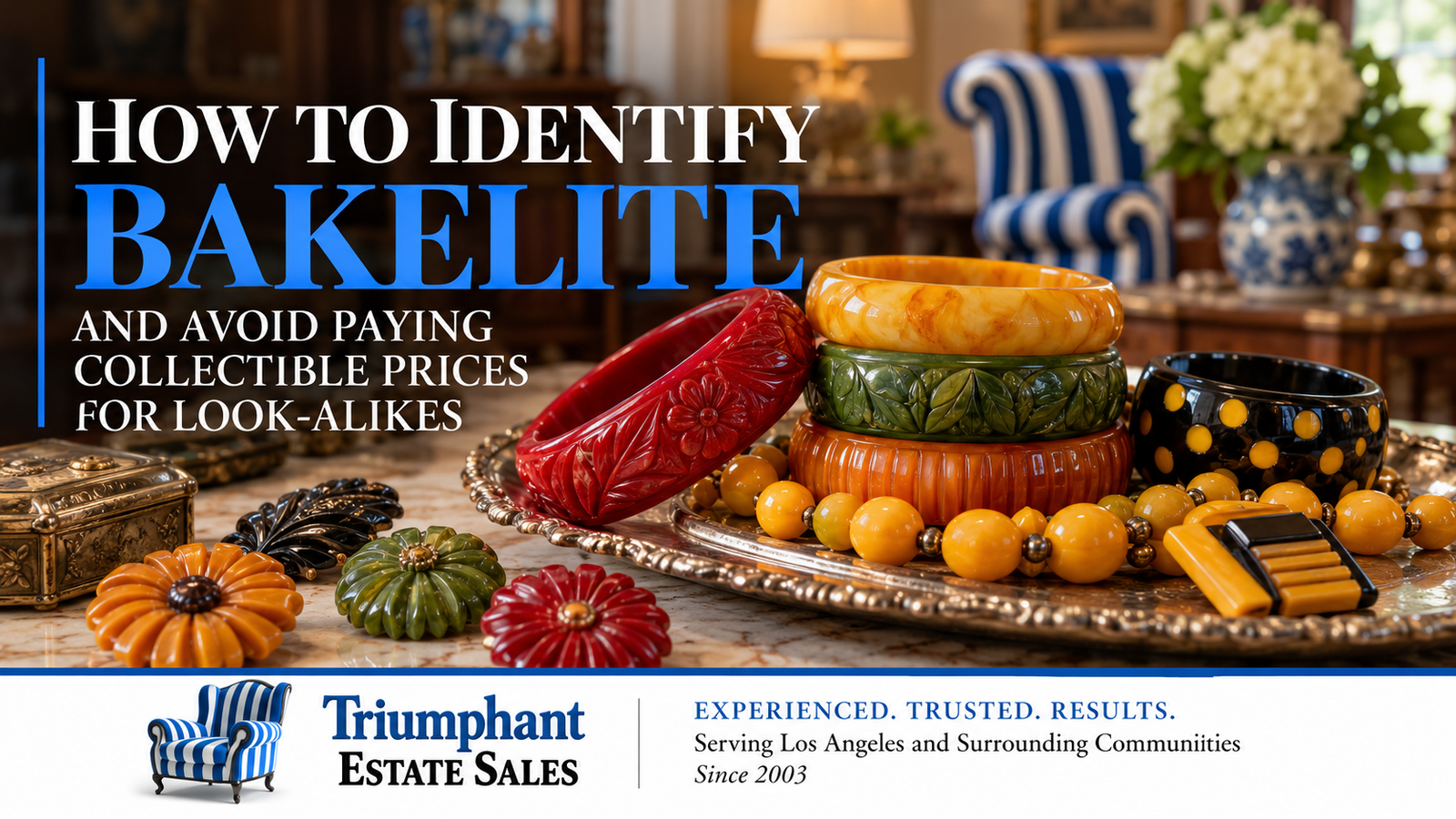
Bakelite, Catalin or Lucite? How to Tell What You've Really Found
Before you pay Bakelite prices for a vintage bracelet, take a closer look at the materials, construction and identification clues that separate these collectible plastics.
I've noticed that when collectors approach a jewelry case at an estate sale, they're often drawn to the same things. A chunky butterscotch bangle, a carved cherry-red bracelet or an interesting old brooch can get someone's attention pretty quickly.
And for good reason. Vintage plastic jewelry has a following of its own. Some people collect particular colors, others look for unusual carving, and some enjoy finding pieces that have been sitting in a jewelry box for decades.
But there's an important distinction between recognizing a bracelet that looks like Bakelite and knowing exactly what you're buying.
That piece could be Bakelite, Catalin, Lucite or another vintage plastic. It might even be a more recent piece made to resemble jewelry from an earlier period. Some of these materials share similar colors and finishes, and several can appear in jewelry from overlapping decades.
Knowing the difference gives you an advantage when you're shopping. It also helps you avoid paying a premium based on a description that may not be entirely accurate.
First, not everything called Bakelite is technically Bakelite
This is where the subject becomes more interesting than the usual identification guides suggest.
Bakelite was one of the earliest commercially successful synthetic plastics. Developed in the early twentieth century, it was used in everything from electrical components and radios to household objects and jewelry.
Traditional molded Bakelite frequently contained fillers, which generally made it opaque. It was particularly useful for durable, molded products.
Catalin came along as a related phenolic resin, but its manufacturing process allowed for a much broader range of bright, translucent and marbled colors. It was particularly well suited to decorative objects and jewelry.
In fact, many of the colorful vintage bracelets collectors casually refer to as Bakelite are technically Catalin or similar cast phenolic material. The San Francisco Airport Museum makes this distinction in its collection of historic plastics.
SFO Museum+1
That's worth understanding before you start trying to separate the genuine pieces from the reproductions.
A Catalin bracelet isn't necessarily a fake Bakelite bracelet. It may be an authentic, collectible vintage piece in its own right.
The question is whether the seller's description accurately represents what you're buying.
Bakelite vs. Catalin vs. Lucite: what are you looking at?
Here's a useful starting point when you're examining vintage jewelry.
Material
What to examine
Important distinction
Traditional Bakelite
Generally opaque appearance, molded construction and possible fillers
A phenolic resin; often associated with darker utilitarian objects as well as some jewelry
Catalin
Rich color, translucency, marbling and carved or polished forms
A related cast phenolic resin frequently sold under the broader Bakelite name
Lucite
Clear or opaque acrylic, varied colors and molded or fabricated designs
A different plastic that can resemble phenolic jewelry
Celluloid
Often lightweight, sometimes thin, molded or made to imitate natural materials
An earlier plastic with different aging and handling considerations
Modern resin
Wide variety of finishes and convincing reproductions of vintage styles
Appearance alone cannot establish its age or authenticity
These are characteristics to investigate, not rules that identify every piece. Manufacturers used different formulations and production methods, and decades of wear, cleaning and refinishing can change an object's appearance.
Historical material distinctions are supported by the San Francisco Airport Museum's collection and published identification references.
SFO Museum+1
The first thing I'd examine isn't the color
Color can get your attention, but I wouldn't make a buying decision based on it.
A beautiful butterscotch bracelet might be Catalin. A transparent bracelet could be Lucite. Another piece might have been manufactured much more recently to imitate an earlier style.
Instead, start by looking at how the piece was made.
Look closely at the carving.
Examine the depth, consistency and finish of carved details. Look inside the grooves and along the edges. Does the workmanship resemble documented vintage examples, or does something about it warrant further investigation?
Look at the material beneath the surface.
Translucency, internal color and marbling can help narrow down the possibilities. Catalin is particularly associated with richly colored, sometimes translucent decorative objects, but these characteristics can be imitated.
Examine the construction.
Look for seams, joins, hardware, drilled holes and signs of fabrication. Compare them with known examples from the period. A seam is a clue about construction, not automatic proof that a piece is modern.
If the bracelet has an elaborate carved design, don't assume that the carving makes it old. And if it's in beautiful condition, don't assume that means it's new. A carefully stored vintage piece can survive remarkably well.
What matters is whether the various characteristics make sense together.
The Simichrome test: useful, but what does it actually tell you?
If you've collected vintage jewelry for any length of time, you've probably heard about the Simichrome test.
Collectors use a small amount of the metal polish on a cotton swab or soft cloth and gently rub an inconspicuous part of an appropriate piece. A yellow or brownish-yellow residue can support the identification of an aged phenolic resin.
But there's a detail worth emphasizing: the test does not reliably distinguish traditional Bakelite from Catalin.
Both are phenolic materials and can produce similar results. So a positive reaction doesn't necessarily establish which material you have, who manufactured it or when the finished jewelry was made.
A negative result doesn't settle the question either. Surface coatings, polishing, oxidation and other factors can affect the reaction.
I also wouldn't start rubbing polish on a piece simply because I'm curious about it. Simichrome is a polishing compound, and testing can affect finishes and surface patina. Painted, decorated, repaired or especially valuable pieces deserve a more conservative approach.
At an estate sale, always ask permission before performing any test.
What about the hot-water test?
Another familiar method involves warming a phenolic piece and checking for a characteristic chemical odor.
The problem is that both Bakelite and Catalin can produce a similar odor. This may help support a phenolic identification, but it won't tell you which of the two materials you're holding.
Lucite, being an acrylic, generally doesn't produce that same characteristic phenolic odor. However, odor is subjective, and finishes or contamination can complicate the result.
Vintage & Retro
I would not expose an unknown piece to hot water just to satisfy my curiosity. Water and heat can damage certain older plastics, glued components, painted surfaces and metal fittings.
And forget the hot-pin test. There's no good reason to permanently mark or damage a collectible bracelet when you're trying to establish its identity.
Why Lucite deserves more attention
Here's something I think collectors should keep in mind: finding out that a bracelet is Lucite rather than Bakelite doesn't automatically mean you've found something uninteresting.
Lucite is an acrylic plastic used extensively in twentieth-century decorative objects and jewelry. It can be clear, translucent, opaque, brightly colored or incorporated into elaborate designs.
8
Collectors may seek particular Lucite designs, makers, construction techniques and decorative effects. A distinctive vintage Lucite piece can have its own market.
The important thing is to identify and evaluate it as Lucite rather than assigning it a Bakelite description because the two happen to look similar.
This is where researching comparable pieces becomes useful. Look at actual completed sales for items with similar construction, size, decoration, maker attribution and condition.
An asking price is simply what someone hopes to receive. It isn't evidence that another collector paid it.
Don't overlook celluloid and other early plastics
While Bakelite, Catalin and Lucite are central to this discussion, they're not the only possibilities in a vintage jewelry box.
Celluloid was used in a wide variety of decorative objects and jewelry. Some pieces imitate ivory, tortoiseshell and other natural materials. It may be relatively lightweight or made in thin, intricately formed designs.
Other early materials include casein-based plastics, sometimes sold under names such as Galalith. Different materials can have their own aging patterns and conservation requirements.
I would be particularly careful about experimenting with an unidentified older plastic. Some materials are sensitive to heat, moisture or chemicals. Celluloid is also notably flammable.
You don't need to identify every possible plastic while standing at a jewelry counter. You do need to recognize when the evidence isn't sufficient to make a confident purchase.
A vintage material doesn't guarantee a vintage bracelet
This is one of the most useful distinctions for collectors who are comfortable with the standard tests.
Suppose a bracelet appears to be made from an authentic older phenolic material. That still doesn't establish when the bracelet itself was carved or assembled.
Old material can be reworked. Jewelry can be repaired, altered or assembled from components of different ages. Reproductions can also imitate vintage construction and decoration.
When the price depends heavily on age, originality or a particular maker, material identification is only part of the investigation.
Look at the overall design. Study the carving and finish. Check the hardware on brooches and dress clips. Examine the areas where components meet, and research documented examples rather than relying entirely on a seller's description.
For a significant purchase, an experienced specialist's examination may be more useful than another home test.
Five things to check before paying a collector's price
01
Know what the seller is claiming.
Is the piece described as Bakelite, Catalin, vintage Lucite, an attributed designer piece or simply a vintage-style bracelet? Those descriptions carry different implications.
02
Separate the material from the age.
Establishing that something is phenolic doesn't independently authenticate the finished piece's date, design or maker.
03
Examine the condition carefully.
Check for cracks, repairs, chips, alterations, damaged hardware and excessive refinishing. Look closely at carved areas and the inside of bangles.
04
Research the closest comparable pieces.
Compare completed sales, not just listings. Pay attention to the differences in size, decoration, attribution and condition.
05
Know when to leave the identification open.
Sometimes the most accurate description is an attributed material or an unidentified vintage plastic pending further examination. You can still appreciate the piece without pretending the uncertainty isn't there.
The advantage of knowing what you're looking at
One of the things I enjoy about estate sales is that an ordinary-looking jewelry box can contain pieces from several different periods. Sometimes everything has been collected by one person over a lifetime. Other times the jewelry has passed through several generations.
That means you may find early phenolic jewelry alongside mid-century Lucite, older celluloid pieces and much newer designs.
For collectors, that mixture is part of the appeal. You never know exactly what you'll encounter until you start looking.
But the person who can distinguish the materials, recognize unusual construction and understand the limits of the familiar tests has more information to work with than someone who relies on color or a label.
And sometimes the overlooked find isn't Bakelite at all. It may be an interesting piece of vintage Lucite, a beautifully made Catalin bracelet or another collectible that deserves attention on its own terms.
Frequently asked questions
Does a positive Simichrome test prove a bracelet is Bakelite?
No. A positive result can support identification as an aged phenolic material, but Catalin can produce a similar reaction. Surface condition and previous treatments can also influence the result. It does not independently authenticate the piece's age or maker.
Is Catalin considered fake Bakelite?
No. Catalin is a related cast phenolic resin and a collectible vintage material in its own right. Much of the colorful jewelry marketed as Bakelite falls within the broader category of cast phenolic jewelry, including Catalin.
Can Lucite be collectible?
Yes. Vintage Lucite jewelry has its own collectors, and interest depends on design, maker, construction, condition and other characteristics. It shouldn't be dismissed simply because it isn't Bakelite.
Can you identify Bakelite by weight or sound?
Weight and sound can provide supporting clues, but they aren't definitive. Construction, thickness and other materials can affect both. Use them as part of a broader examination.
How can I tell whether a carved bracelet is an original vintage piece?
Compare its material, carving, finish, construction and wear with documented examples. Remember that an older material may have been carved or reworked later. If originality substantially affects the price, consider a specialist examination.
Before your next estate sale
The next time you see a tray of colorful old bracelets, don't stop at deciding whether one looks like Bakelite. Take a closer look at what it's made from, how it was constructed and whether the asking price reflects what can actually be established about it.
That extra attention is part of what makes collecting interesting. You learn to recognize things you might have walked past a few years ago, and you become more selective about the pieces you decide to bring home.
At Triumphant Estate Sales, we regularly encounter collections assembled over many years, from vintage jewelry and decorative objects to household items whose history isn't immediately obvious.
If you're shopping our Los Angeles estate sales, take your time with the jewelry. You never know which piece will give you something new to investigate.