
Before You Toss Your Kids' Old Stuff: Why '90s and Y2K Collectibles Matter
· Todd Larsen, Triumphant Estate Sales
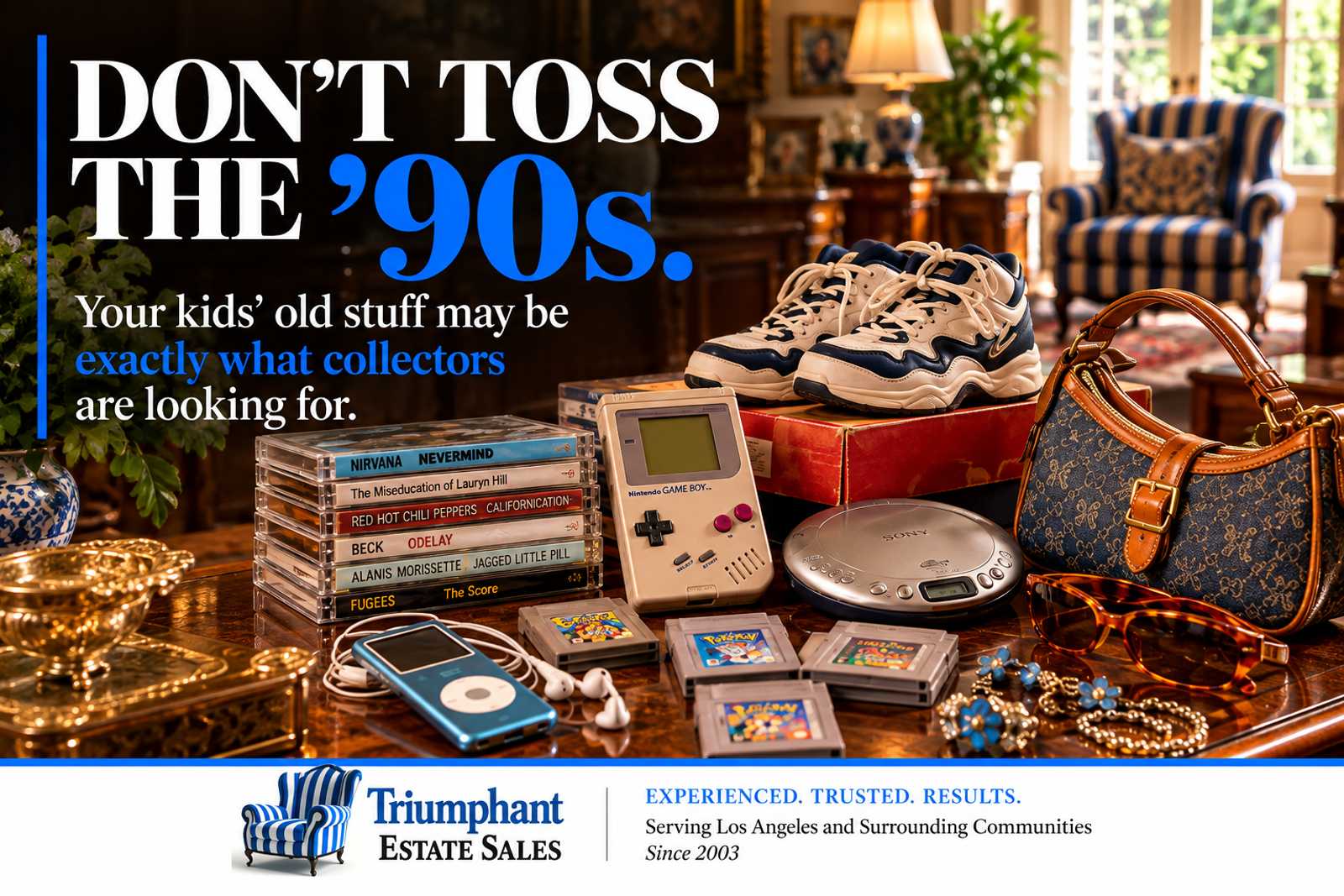
Before You Toss Your Kids' Old Stuff: Why '90s and Y2K Collectibles Matter
The old video games, sneakers, CDs and electronics that families once considered too recent to be valuable are finding a new generation of collectors.
There's a moment that happens when we're walking through a house before an estate sale. We'll get to a back closet, a garage or one of the bedrooms that hasn't changed much since the kids moved out. Someone opens a box, pulls out an old video game or a chunky portable CD player and asks whether we can just get rid of it.
It's an understandable question. If you're sorting through an entire house, you have to make decisions about thousands of things, and a box of your children's old stuff doesn't necessarily look like a priority.
But I wouldn't be so quick to throw it away.
Some of the things people remember buying at the mall in 1998 or putting on their Christmas lists in 2002 are now attracting collectors who remember them just as clearly. Other buyers are discovering those same things for the first time through fashion, music, social media and online resale.
That doesn't mean every old CD player or pair of sneakers has suddenly become valuable. It means we need to look at a different part of the house than we might have concentrated on twenty years ago.
And it raises an interesting question: when did the things we remember as relatively new become vintage?
The '90s and Y2K are becoming someone else's collecting era
I think one of the biggest changes in estate sales is that different generations are walking into the same house looking for entirely different things.
One buyer may head straight for the antique furniture, sterling silver and art. Another may want the mid-century lamps. Someone else might walk past both of them because they spotted a pair of early-2000s sneakers in the closet.
They're all shopping the same estate, but they're responding to different memories, tastes and collecting interests.
For younger buyers, the late 1990s and early 2000s can represent the same kind of nostalgia that earlier generations felt for the objects of their own childhoods. The original video game they saved up to buy, the handbag they couldn't afford, the music they listened to on the way to school or the sneakers they wanted but never owned.
There's also an audience that wasn't old enough to experience that period firsthand. They may be discovering it through fashion, online communities and older media.
The broader secondhand clothing market reflects this growing participation. ThredUp's 2026 resale report, based partly on a survey of 3,268 U.S. adults, projects that Gen Z and millennials will account for 71% of secondhand apparel market growth through 2030. That is an apparel-market projection, not a measurement of estate sale attendance, but it helps explain why younger shoppers are increasingly important to resale businesses.
ThredUp Newsroom
For us, the practical question is what that means when we're walking through a home with a family.
It means we shouldn't decide what matters based solely on how old something is.
What '90s and Y2K items should you check before donating?
1. Video games, consoles and original packaging
This is one of the first categories I'd examine when we come across a box of children's belongings. Original Game Boys, Nintendo 64 systems, PlayStation consoles, Game Boy Advance games and other systems from the period have established collector markets.
What interests me is how much difference the small things can make. A game with its original box, manual and inserts is not necessarily the same product, from a collector's standpoint, as a loose cartridge found at the bottom of a drawer.
Collectors commonly distinguish between loose, complete-in-box and sealed games. PriceCharting maintains separate historical sales data for these conditions, which is useful when researching a specific title.
PriceCharting+1
That doesn't mean every game is valuable. Many were produced in enormous quantities, and demand varies considerably. But if the boxes and manuals are still around, keep them with the games until everything has been identified.
2. Streetwear, sneakers and clothing from the period
A lot of families have a very clear idea of which clothes they think are worth saving. The expensive formalwear gets set aside, while the old T-shirts, hoodies and sneakers are considered everyday clothing.
But those everyday pieces can be exactly what another buyer is looking for.
Vintage Nike, Stüssy, Supreme and other labels associated with particular periods or designs have their own resale audiences. The same goes for selected denim, graphic T-shirts, sportswear and recognizable early-2000s styles.
Before assigning a price, I want to know what the item actually is. The label, date, particular design, size and condition all matter. A common later reproduction shouldn't be priced as an original release, and a desirable design with significant damage needs to be evaluated accordingly.
For sneakers, keep the original box if it's still there. Check the soles, interiors, labels and signs of deterioration. Shoes can look wonderful sitting on a shelf and still have problems that become obvious when someone tries to wear them.
3. Electronics that look obsolete to one person and nostalgic to another
Remember the portable CD player that skipped every time you hit a bump? Or the original iPod, translucent electronics, handheld organizers and flip phones that seemed so advanced at the time?
Some people collect the objects themselves. Others want a working example because they enjoy using older technology. And some simply want the particular model they remember owning.
But this is a category where you need to be careful about assuming value. Common electronics may have little resale demand, and an untested device isn't the same as a working one.
Check the model number, accessories and original packaging. Look for corrosion in battery compartments. Don't discard chargers, cables or manuals before identifying what belongs together.
And if you find an old phone, computer or music player, consider whether it contains personal information before selling it. Data removal is a separate step from determining collector value.
4. CDs and music collections
I wouldn't treat an entire box of CDs as collectible simply because physical media has a nostalgic following. Most collections contain a mixture of common titles, less common releases and sometimes a particular pressing that deserves more research.
What I would do is look at the collection before selling it as one inexpensive lot or sending it off for donation.
Original pressings, limited releases, certain independent labels, promotional discs and complete collections can attract specialized buyers. Condition matters, especially when a buyer is looking for a particular release rather than just a copy of the album.
Keep the inserts and original cases with the discs. Look at the catalog numbers and release details when researching comparable sales. A title alone isn't always enough to identify the exact version.
It's also worth remembering that the music market isn't one single trend. Vinyl, CDs, cassettes and digital music serve different audiences. A collector's interest in a specific CD pressing doesn't mean the average box of CDs has become valuable.
5. Y2K handbags, jewelry and accessories
The closet deserves a second look, and not just for the designer pieces that everyone already recognizes.
Small shoulder bags, recognizable early-2000s designs, chunky costume jewelry, sunglasses, belts, butterfly clips and other accessories may appeal to people collecting or wearing fashion from that period.
Some pieces are desirable because of their maker. Others are interesting because of a particular design or because they represent a recognizable moment in fashion.
The important thing is to separate the genuine period pieces from later reproductions and current styles inspired by the era. A Y2K look isn't the same as an item actually made during the Y2K period.
If you have a handbag with its original dust bag, receipt or tags, keep those together. Check the interior, handles, hardware and any signs of repairs. Those details can help with identification as well as resale.
Why families overlook these things
The interesting part is that the things a family considers important and the things a collector wants aren't always the same.
If you inherited your parents' home, you may immediately recognize the antique dining room furniture or a painting that's been in the family for years. You might not give much thought to the plastic storage bins filled with things your children left behind when they went to college.
The problem isn't that the dining set doesn't matter. It's that the other boxes may never get examined.
When we're helping a family sort through an estate, I don't want them to assume that everything manufactured in the last thirty years is disposable. Nor do I want them to assume that every item with a little nostalgia attached to it is valuable.
Both assumptions can lead to poor decisions.
The better approach is to identify what you have, look at its condition and completeness, and determine whether there's a real market for it.
The original box might matter more than you think
One of the most common mistakes in clearing out a home is separating things that belong together.
The video game goes into one box, the instruction manuals into the recycling and the original packaging into the trash. Someone decides the old sneaker box is taking up too much room, or a collection of CDs gets separated from its cases.
For certain collectibles, those decisions can affect resale value.
In the video-game market, for example, pricing services explicitly distinguish loose games from complete-in-box and sealed examples. That's a useful reminder that you need to identify the entire item, not just the object in your hand.
PriceCharting
Before clearing a room, I'd keep related items together and photograph anything that might help establish the original contents.
What determines whether a '90s collectible is worth selling?
Age and nostalgia can attract attention, but they don't establish a selling price.
For these categories, I look at several things: the exact model or release, originality, condition, completeness, actual buyer demand and comparable completed sales.
A common video game and a limited-release game shouldn't be evaluated in the same way. A damaged pair of sneakers may have a very different market from an unworn example. And a CD advertised online for an ambitious price isn't necessarily selling at that price.
That's why I prefer researching actual transactions rather than building expectations around asking prices or stories about extraordinary finds.
It's also why the way an item is marketed matters. A buyer looking for a specific game, designer or electronic model needs enough information to recognize it. Good photographs, accurate descriptions and the right audience can make a difference.
Before your estate sale, check these five places
01
The children's old bedrooms
Check closets, drawers, shelves and storage bins for games, toys, clothing, music and electronics.
02
The garage
Look for original packaging, sporting goods, sneakers, consoles and electronics that were moved out of the house years ago.
03
The hall and linen closets
These often become temporary storage places for things nobody knows what to do with. Sometimes temporary means twenty years.
04
The media cabinets
Keep games, CDs, consoles, controllers, cables and manuals together until they're identified.
05
The boxes already marked for donation
If nobody has looked through them carefully, give them one more examination before they leave the property.
Frequently asked questions
Are '90s and Y2K items considered antiques?
Generally, no. In the collecting market, these objects are more accurately described as vintage, retro or contemporary collectibles, depending on the item and context. Their appeal doesn't depend on meeting a traditional definition of an antique.
Are old video games worth anything without their boxes?
Some are. The exact title, platform, condition and demand matter. Original packaging and manuals can affect the price, so keep them when available.
Are old CDs becoming collectible?
Certain releases and pressings have specialized collector markets, but common CDs may have modest resale value. Identify the exact release and examine completed sales before assigning a price.
Should I throw away old electronics that no longer work?
Not before identifying the model and checking whether collectors buy it for parts, restoration or display. Some nonworking devices have little resale demand. Protect personal data and dispose of unwanted electronics responsibly.
What should I do before donating a collection of Y2K clothing?
Look at the labels, original tags, specific designs and condition. Keep matching accessories and packaging together, and research comparable completed sales for pieces that may have collector interest.
The next time you're cleaning out a closet
I understand why families want to start clearing things out before an estate sale. There's a lot to do, and getting rid of what looks like ordinary clutter can feel like progress.
But the garage, the back closet and the old bedroom are exactly where I'd slow down for a moment.
The things that look too recent to matter to one generation may be the things another generation remembers, collects or has been trying to find.
That doesn't make every box from 1999 a treasure. It simply means we shouldn't decide what something is worth before we've taken the time to see what's actually there.
At Triumphant Estate Sales, that's part of how we approach a house. We look at the traditional antiques and furnishings, but we also examine the clothing, collectibles, electronics and everyday objects that can appeal to a very different group of buyers.
If you're preparing for an estate sale in Beverly Hills, Hollywood Hills, Pasadena, San Marino, Toluca Lake, Encino or the surrounding Los Angeles area, let us look through the house with you before you start throwing things away.